Every day, Canadians scroll past claims about their food that are designed to alarm first and inform second. A single dramatic headline about “toxins” or “chemicals” can spread faster than the research needed to put it in context. For an organization built on connecting consumers with farming and food, this is exactly the gap Canadian Food Focus (CFF) works to close.
That is the thinking behind Food Facts, Not Fear, CFF’s ongoing reel series with registered dietitian and professional home economist Erin MacGregor (erinmacgregor.com), published on Instagram, Facebook and TikTok. Rather than responding to one viral claim at a time, the series takes a different approach: teaching Canadians to recognize the persuasion tactics that misinformation relies on, so they can evaluate the next claim they see on their own.
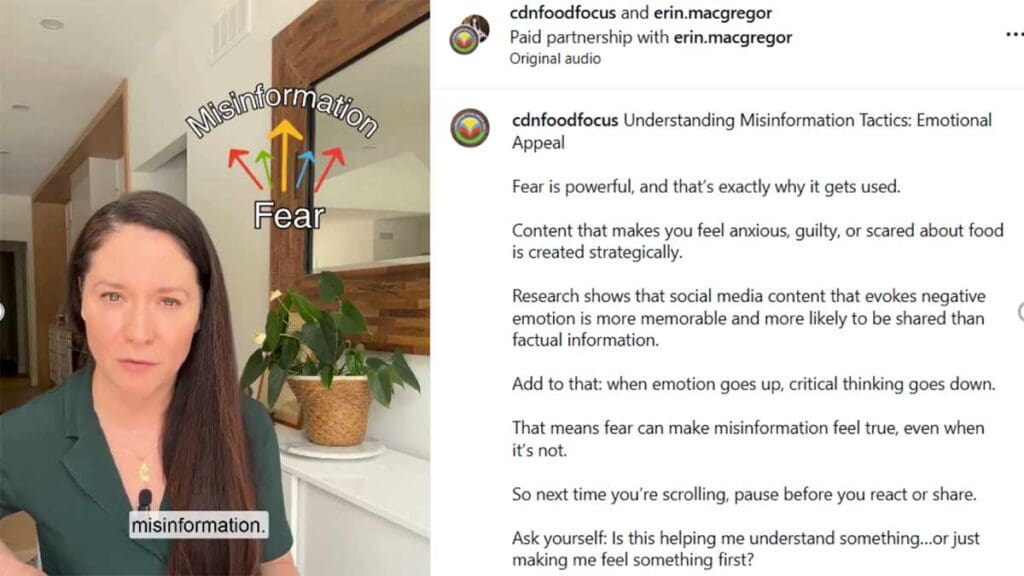
What the series covers
Each reel is short, conversational and focused on a single tactic. Since the series launched, it has covered:
- Emotional appeal: Content that makes people feel anxious or afraid tends to be shared more than neutral, factual content. The reel explains why fear-based posts about food feel more convincing than they actually are and encourages viewers to pause before reacting or sharing.
- The appeal to nature fallacy: “Natural” does not automatically mean safer or better, and “synthetic” does not automatically mean harmful. Using examples like poison ivy and synthetic folic acid, the reel shows why labelling alone is not evidence.
- Chemophobia: Words like “chemicals,” “toxins” and “poisons” are used to trigger fear, even though everything, including the food we eat and our own bodies, is made of chemicals. The reel points out that a claim which never mentions dose or exposure level is a warning sign.
- Cherry-picking: Selecting a single study or data point that supports a narrative, while ignoring the larger body of evidence, is a common way to misrepresent nutrition science. The reel encourages viewers to ask whether a claim reflects the full picture or a chosen slice of it.
Each post follows the same format: a clear on-screen label for the tactic, a plain-language explanation, and a simple question viewers can ask themselves the next time they see something similar in their feed.
The series continues in the months ahead. The next two reels will address conspiracy framing, which draws people toward claims that food or health information is being hidden from the public, and the difference between correlation and causation, a common source of confusion when two things appear linked but one does not actually cause the other. As with the earlier reels, each will give viewers a clear, plain-language way to recognize the tactic on their own.
CFF is also planning to compile the reels into a Misinformation Toolkit for food and health professionals, extending their use beyond social media into a resource that dietitians, educators and other trusted voices can draw on directly in their own work with the public.
Why this matters to our partners
Public trust in Canadian food and farming is built one credible interaction at a time, and misinformation erodes that trust faster than any single fact sheet can repair it. By giving Canadians a repeatable way to question what they see, rather than a list of claims to memorize, this series supports the same goal that brings our stakeholders to the table: a public that can make confident, informed food choices based on science rather than fear.
If your communications or policy teams see value in amplifying these reels, referencing this approach in your own consumer-facing content, or exploring a more formal partnership around food and nutrition misinformation literacy, we would welcome that conversation. Please reach out to Canadian Food Focus to discuss how we can work together on this priority.
 Canadian Food Focus Hosts Farm Tour with Food Influencers